Caroline Seaton at Amberley Pottery

Caroline Seaton in the Amberley Pottery

This week I am in the company of Caroline Seaton at her Amberley Pottery.
I ask Caroline about her life as a potter at Amberley. She replies “I am incredibly grateful for the fact that I love making pots. I lost my husband and then when my mother died I became an elderly orphan. This [place] has been my reason for getting up each day. I still after all these years like the materials. I get tremendous pleasure and excitement unpacking the kiln. It’s out of your control you’ve done what you can but sometimes you get a tremendous surprise, or sometimes not.

I’m so grateful for the fact that I come round here. I don’t ever get bored so I’m very thankful for that.” Caroline has been at the Amberley Pottery for some 40 years, and potted from home before that.

I comment on how I have always admired Caroline’s resilience and grace because whatever life throws at her she’s always put her apron, dusted off her pots and pressed on. Caroline smiles and replies “Well what else would you do?” I agree.

She continues “Since my husband and my mother died the pottery has managed to just fill in all the empty spaces for me without it being a conscious decision so I am grateful and I say a prayer every day to say how thankful I am.”
I suggest that she is called to be a potter and that there would be no peace without making pots and she agrees.

I ask Caroline what inspires her and how she would describe herself. She answers, “I’m a practical potter. I love the materials, the physical side of it, I like working with the clay it opens my mind. So I don’t sit down and draw a design or make out a recipe for a glaze, it’ll come to me while I’m working. The glazes are inspired by the customers and reflect what they like. I don’t make beautiful pottery I make lumpy bumpy country pottery for people to use. It’s tough but if it gets broken I hope you enjoyed using it while you had it.” I interrupt Caroline to say that those handmade qualities are precisely the reasons that I think her pottery is beautiful.

Caroline explains how she has a deep sense of unexpected blessings in her life – unasked for opportunities which have been offered to her and which she has said yes to. “Yes, I have this feeling that you can’t actually organise your life. I think things happen and you either decide to go along with it or you don’t, you make a choice. I’m happy in my own company, a solitary person yet perfectly sociable. I don’t need a radio.”

As we talk visitors and locals process in to chat, choose and buy Caroline’s pottery.

The famous Amberley blue glaze and blue and white expressed in decorative and useful pottery.

Caroline Seaton’s life at the Amberley Pottery provides a constant, a point of stability at the heart of our community. The beauty of her handmade decorative and domestic pottery connects us to this outward facing, generous, practical potter whose work enriches our daily lives by its use.

The Amberley Pottery is open on Thursday, Friday, Saturday and Sunday from 11.00am to 3.00pm. To find out more visit www.amberleypottery.co.uk
Ben Nicholson: From the Studio

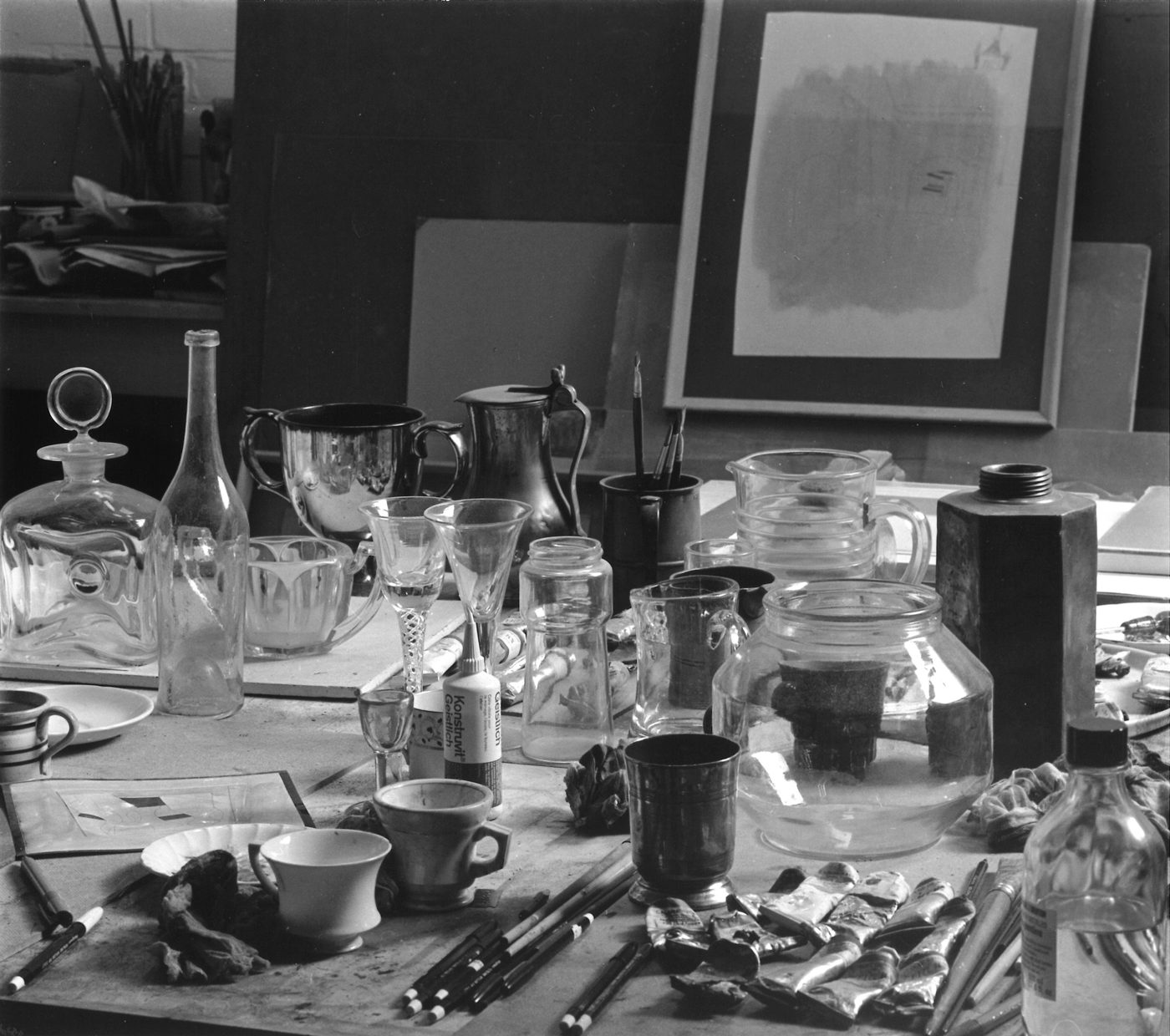
John Webb, Ben Nicholson’s Studio, London, 1982 © The Late John Webb FRPS

This week I am in the company of Pallant House Gallery Director Simon Martin exploring the gallery’s latest exhibition Ben Nicholson: From the Studio.

I ask Simon about the central themes of the exhibition, he replies “During a career spanning six decades Ben Nicholson used the humble still life as a vehicle for experimentation. It’s interesting how antique objects inspired one of our most famous modernists. There is a real sense of his pleasure in objects in his work.”

The exhibition looks at the inspiration of objects whilst telling the story of the relationships in Ben Nicholson’s life. In particular his artistic and romantic relationships with his wife Winifred Nicholson and Barbara Hepworth.

In a letter to a friend, Nicholson acknowledged ‘I owe a lot to my father…not only from what he made as a painter, but from the very beautiful striped and spotted jugs and mugs and goblets, and octagonal and hexagonal glass objects he collected. Having those things in the house was an unforgettable early experience for me.’

This creative exhibition explores the importance of still life and the studio within Nicholson’s art from his early, highly finished realist paintings to the abstract reliefs that secured his international reputation. Distinctive striped jugs, mochaware mugs and glassware are displayed alongside the paintings, carved reliefs and works on paper which they inspired. The photograph of Nicholson’s studio shows it filled with objects.

Nicholson would move from painting in a realist way to a faux-naïve manner, and then to abstraction with the development of an interplay between space and depth in his famous carved relief panels which explore the same interests but with a new vocabulary.

Ben Nicholson and Barbara Hepworth were influenced by their time in Paris where they spent time with Constantin Brȃncusi, Hans Arp, Pablo Picasso and Georges Braque, all of whom had explored cubism and abstraction through objects.

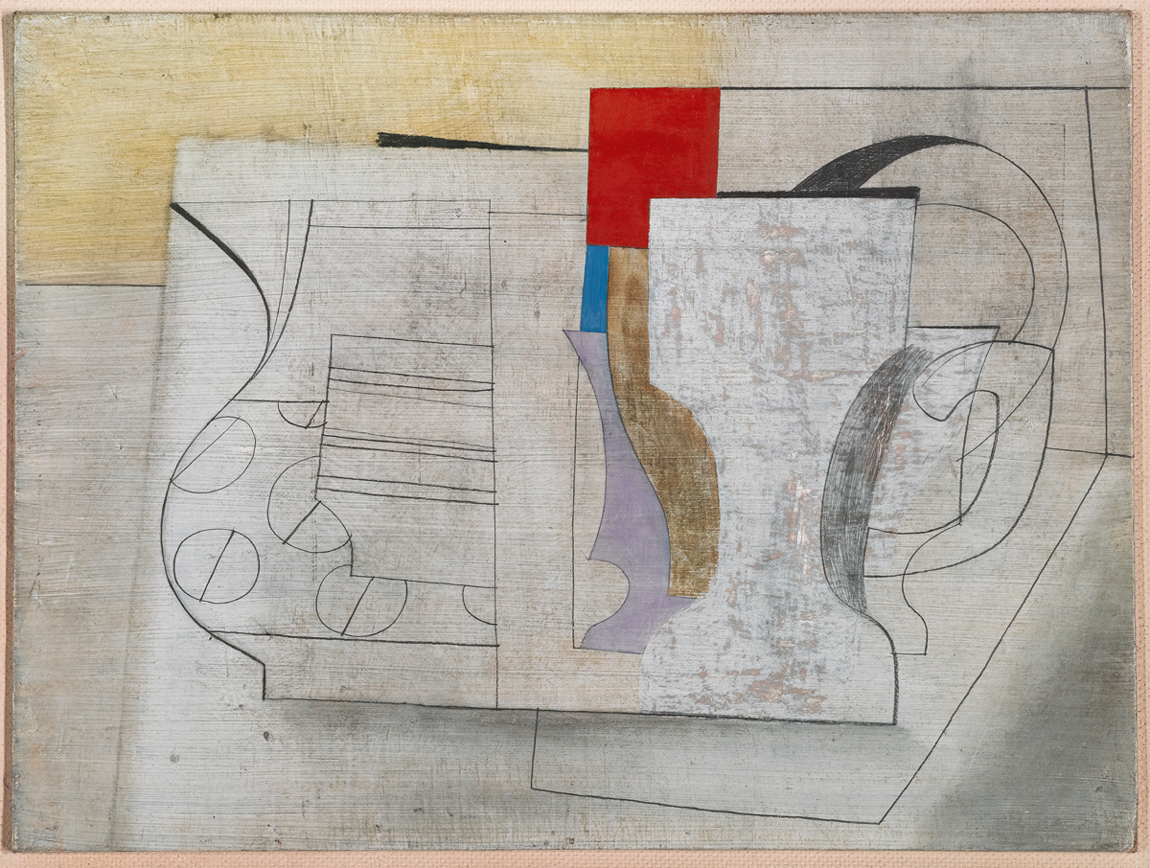
Ben Nicholson, June 16- 47 (still life), Oil and pencil on board, Private Collection, © Angela Verren Taunt. All rights reserved, DACS 2021

The abstract June 16 – 47 (Still Life) expresses the joy and stability in being accompanied in life by beautiful objects be they humble ceramics, glass, or paintings and sculptures by one of the most important artists of the 20th century.

The wholeness of the art and objects exhibited together reminds me of the aesthetic of Jim Ede’s home Kettles Yard in Cambridge. Jim Ede would acknowledged the influence of Ben and Winifred Nicholson on him.

Simon Martin concludes “These objects were a vital presence in the numerous studios Nicholson inhabited during his life and were of central importance in his still life paintings.”

The beautiful works on show, the very personal narrative provided by the objects and the focus on Nicholson’s relationships gives this refreshing exhibition a rich textural quality – modern but not minimalist.

Ben Nicholson: From the Studio runs at the Pallant House Gallery, Chichester until the 24th October 2021.

Live Premier of a New Concerto Inspired by Sussex

Andrew Bernardi and the 1696 Stradivarius preparing for the live premier of Paul Lewis’ new Violin Concerto © Malcolm Green 2020

This week I am in the company of Andrew Bernardi bathed in the dappled light in his garden. The Shipley Arts Festival has commissioned a new Violin concerto by the acclaimed Sussex composer, Paul Lewis.

I ask Andrew about this exciting new commission. He replies “Paul Lewis who’s been a friend now for well over 10 years and a part of the festival is a composer who lives in Sussex. He’s written a wonderful violin concerto. The minute we began to rehearse it we knew it was going to be a hit.

We’re going to be playing the whole concerto which is very cleverly written. The opening movement is titled 1696 Stradivarius. The intervals at the beginning are one-six-nine-six after the year the Stradivarius was made.”

The second and third movements are titled Shipley Idyll and Chinese Adventure.
Andrew says “This [concerto] is a real story that comes out of Sussex. Paul’s very cleverly also continued our journey which, as you know, has gone across Asia, so the concerto ends with Chinese Adventure.” Andrew’s important cultural dialogue with China has continued throughout the pandemic as have his performances with the Shipley Arts Festival embracing the opportunities of online concerts during lockdown. Andrew is delighted by the opportunities the technology has provided and to be performing in front of audiences once again now restrictions are easing.

I remark that he is rooted and sent from Sussex. Andrew smiles and agrees. Shipley has such big place in his heart I ask him what it is like to play the Shipley Idyll movement. He pauses to reflect and says “It’s very beautiful, very witty, brilliantly written and very challenging to play I might add.”

He continues “It reminds me of going down the river from here at our house which carries on to the church and goes through the Knepp Estate and eventually ends up in the sea. And that kind of describes what music does. That idea of something small becoming something huge. I think the river system brilliantly reflects this. So that’s what I think the Shipley Idyll reflects. You go out and find all these beautiful places and then you meet all these wonderful people on your journey and then you’re part of the sea, this amazing thing that you never knew was so large.”

As Andrew talks it seems to me that this could also be a metaphor for the growing national and international reputation of the Shipley Arts Festival here in Sussex.

Andrew plays me the Shipley Idyll movement. It is deeply moving, hope filled, shimmering descriptive, like the changing seasons, it seems to capture the passage of time and love – the pilgrimage of life in a Sussex landscape.
Andrew describes how for him the character of Sussex is born out of its people.

He concludes “My friends, the people here in Sussex are really warm hearted, hospitable, open and sharing, like the countryside. That’s what it’s all about.”
Andrew Bernardi’s generosity of spirit is at the heart of the Shipley Arts Festival with its community of musicians and supporters. Paul Lewis’ beautiful Violin Concerto’s live premier will be at Nuthurst Church on 18th July 2021. To book tickets for this and other concerts in the 2021 Shipley Arts Festival season visit bernardimusicgroup.com/events.

Global Art Market Report Highlights Future Growth in Collecting

Furnishing sustainably with English Country House art and antiques © Toovey’s 2020

The findings of the 2021 Art Basel and UBS Global Art Market Report highlights the trends we are witnessing here in Sussex with future growth in collecting.
Covid-19 has affected our lives in so many different ways, there have been joys and sorrows. And yet those I meet are hopeful about the future.

In the auction, art and antique world I have witnessed a collecting boom alongside the tender shoots of a renaissance of interest in more traditional art and antiques. English Country House Taste, which the young are now calling The New Minimalism, gives expression to their desire to have a minimal impact on the world by celebrating older furniture and objects which make no demands on the world’s precious resources. Women, too are having a stronger influence on collectors’ markets. The huge investment in our online offer over many years has brought dividends to our clients as collectors have embraced our digital showroom.

However, collectors and sellers have been delighted to return to the salerooms and sales once again by appointment.

The report notes that the US retained its position as market leader in 2020 with a share of 42% of global sale values. For the third year running the UK maintained its second place position with a 20% share but this year on level pegging with China.

The report illustrates how the digital transformation has accelerated as auctioneers, galleries and fairs moved their sales online in response to the challenges of Covid-19. Perhaps unsurprisingly online sales doubled in value from 2019 to reach a record high of $12.4 billion. The report highlights that for the first time the share of e-commerce in the art market exceeded that of general retail. The figure represented a record 25% share of the market’s total value.

The collectors surveyed remained actively engaged with the art market. Despite having fewer opportunities to buy in person they purchased almost as many items in 2020 as they had in 2019.

Online and in person, report highlights future growth in collecting © Toovey’s 2021

Among the most exciting statistics in the report 66% of those surveyed said the pandemic had increased their interest in collecting, and one third (32%) said significantly. This increase shows the resilience and appeal of our market and matches our experience at Toovey’s here in Sussex. The majority of collectors noted their intention to be active in 2021, with 57% planning to purchase more work.

Foot traffic data from UBS Evidence Lab offered early indications of renewed visits to commercial galleries in 2021 and that has been our experience too.
An exciting development is the continued growth in women’s buying power and influence in the market. In 2020 women spent more than men with their average expenditure rising 13% year-on-year.

Millennials are also becoming influential in the market and are more likely to be active online, the report noting greater use of online viewing and social media.
The trend towards future growth in collecting and furnishing in a sustainable way in the looks set to continue with Britain maintaining its success in the global art market.

Stewarding the Sussex Landscape

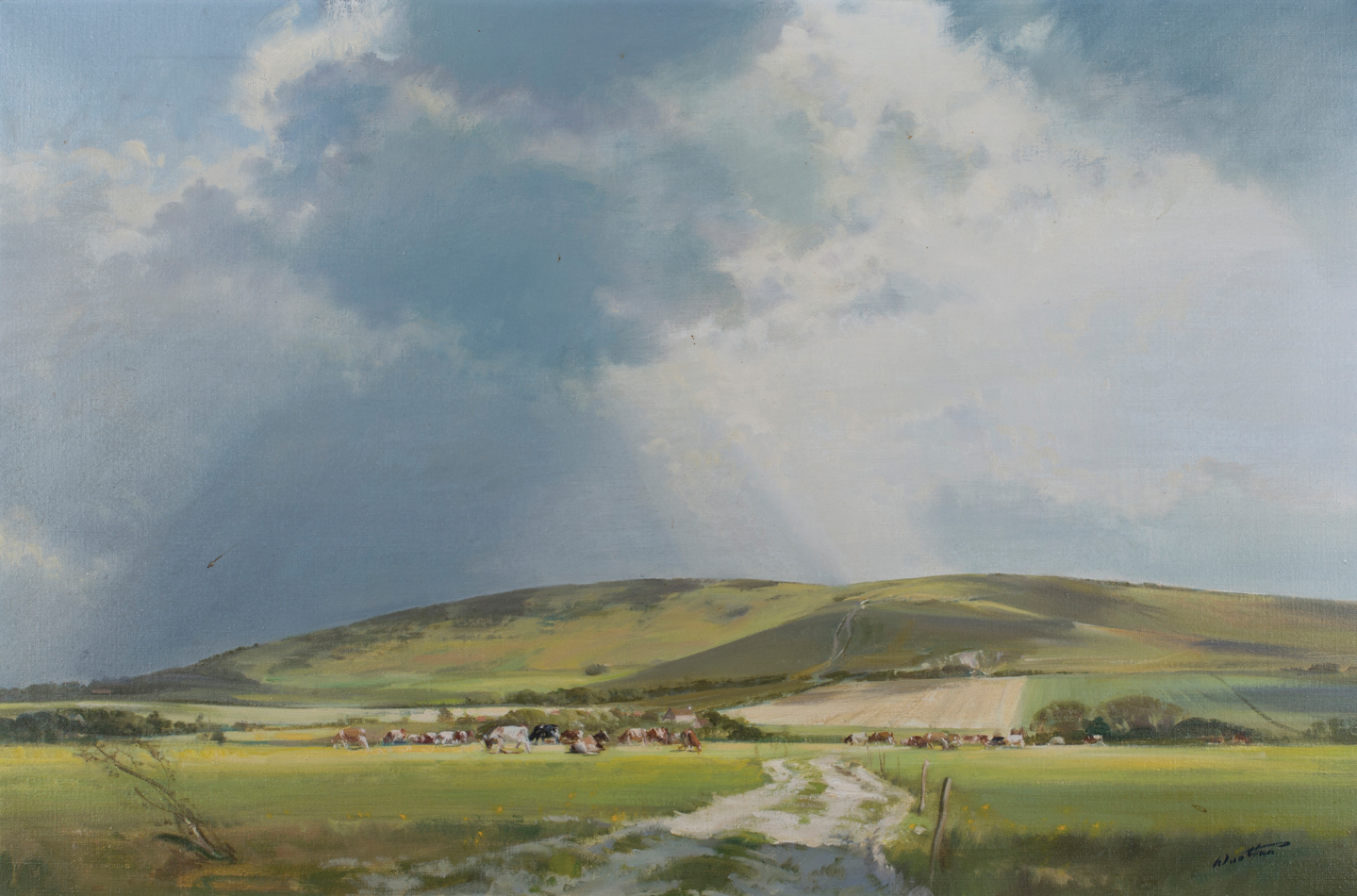
Frank Wootton’s oil on canvas ‘A Passing Storm, Windover Hill, Sussex’ © Toovey’s 2021

The South Downs have for centuries been shaped by farming. The ancient, managed chalk grasslands are still maintained on some of the steep downland slopes. The rich biodiversity of birds, fauna and insects predate on those that eat the crops. In the valleys and open fields mixed farming ensures that the fertility of the soil is improved and maintained by the under planting of cereal crops with rich clovers and grass grazed by sheep and cattle in seven year crop rotations to limit disease. Some of the most balanced and sustainable farming practice in the country is to be found in the leas of the South Downs.

The oil painting titled ‘A Passing Storm, Windover Hill, Sussex’ by the Sussex artist Frank Wootton. OBE (1911-1998) depicts a rural idyll with grazing cattle beneath the majesty of the Sussex Downs. It sold at Toovey’s for £2600. You sense the heat in the tone and palette of the scene. The storm casts its shadow, moving quickly across the landscape as the rain falls. It is this quality of landscape which speaks into the very identity of our nation. What the Shipley poet Hilaire Belloc described as ‘The great hills of the South Country, They stand along the sea’.
Frank Wootton studied at The Eastbourne College of Art under Eric Ravilious and Arthur Reeves-Fowkes. Whilst his landscapes and equestrian scenes are celebrated Wootton is perhaps most famous for his aeronautical paintings.
In the late 19th and 20th centuries many of Britain’s leading artists were inspired to leave London, our towns and cities for the country. For some it was to escape the effects of the industrial revolution and for others the wars

And here’s the thing, that sense of the rural idyll remains alive in popular culture and the public’s imagination. In contrast we have become more and more removed from the reality of country life even though the debate around farming in this country is entering into our national conversation.

The overwhelming majority of the farmers here in Sussex work constantly to achieve a balance between maintaining the fertility of the land, producing food in a sustainable way for the nation with close attention to the preservation of nature.

In a mixed agricultural response to the challenges of climate change it is vital that we seek to restore our soils and feed the nation through mixed agriculture. Local food supply chains, balanced mixed farming, and working with nature must surely have a dramatically reduced carbon footprint over the alternative of importing our food on hugely polluting ships and planes.

Our farmer’s continue to steward the landscapes which have inspired artists and musicians over the centuries and never more so than in Sussex in the 20th century. In our hearts and minds the countryside with its generous communities connected with the seasons and the abundance of the land have provided hope against the back drop and grind of urbanisation.

Walking with nature and in conversation with those we love is a great blessing. Our countryside, maintained by our farmers, is the perfect place for a day’s holiday-after all Sussex has some of the most beautiful landscapes in the world. And we must do our best to support our Sussex farmers as we shop.