Rupert Toovey’s articles in the West Sussex Gazette

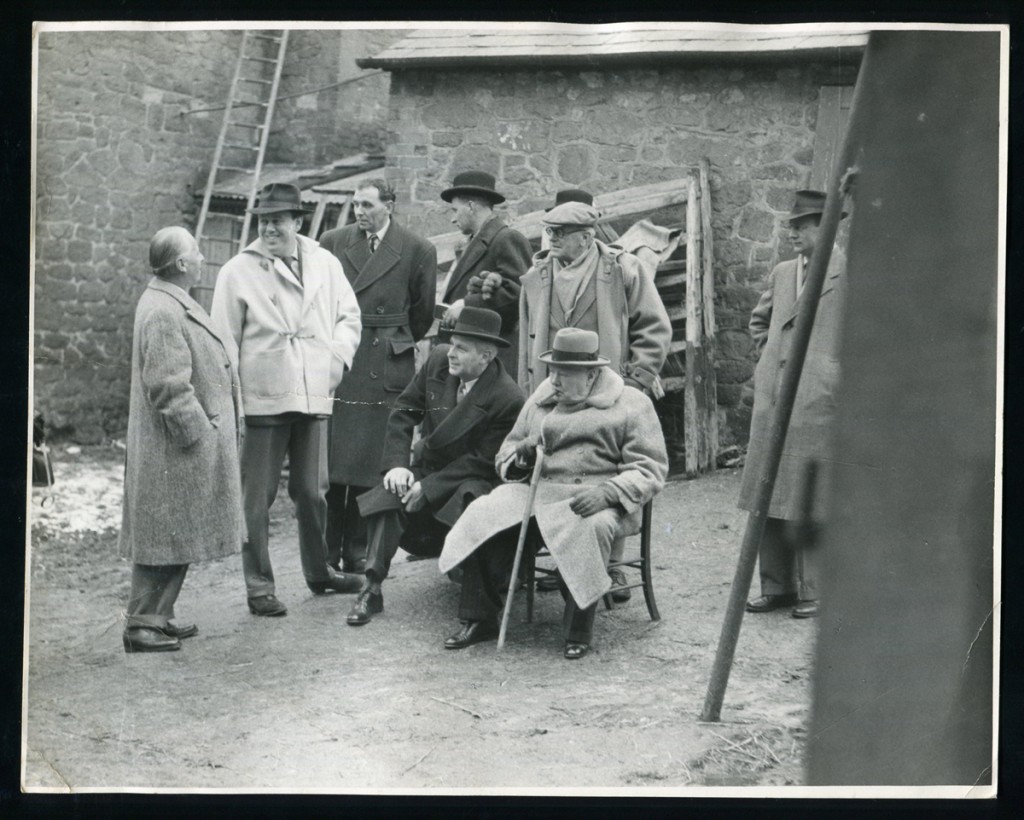
Winston Churchill and Percy Cox at Chartwell

Every week Rupert Toovey, senior director of Toovey’s, writes an article for the West Sussex Gazette newspaper. If you would like to read an archive of Rupert’s articles you can do so on the Toovey’s blog by clicking here. You can always read Rupert’s articles first in the West Sussex Gazette. His article this week was on the fascinating Percy Cox archive to be offered for sale in Toovey’s auction of Paper Collectables on the 5th November. Click here to read the article.
Sir Winston Churchill and Chartwell

Winston Churchill and Percy Cox at Chartwell
Percy Cox OBE wearing a flat cap, standing behind Sir Winston Churchill at Chartwell, image from the Percy Cox Archive

Sir Winston Spencer Churchill bought Chartwell in 1922. It was to be home to the Churchill family over the next forty-three years. Toovey’s paper collectables specialist, Nicholas Toovey, has uncovered a small archive of photographs, letters, telegrams and notes, which document the Churchills’ relationship with their friend and estates manager, Percy Cox, OBE. The correspondence and images give a very personal insight into life at Chartwell. The Percy Cox Archive is to be auctioned in November at Toovey’s.

View from Chartwell
The view from Chartwell looking south over the gentle landscape of the Weald of Kent

Churchill’s youngest child, Lady Mary Soames, has written that her father was “captivated by Chartwell from the moment he set eyes on the valley, protected by the sheltering arm of beautiful beech woods… and by the house on the hillside”. As you stand on the terrace at Chartwell, you are presented with a southerly view over the gentle landscape of the Weald of Kent; it speaks of an older England. Unsurprising, then, that this scene so inspired our greatest war-time Prime Minister. Whenever the English find themselves under threat, they turn to their monarch, their church and their landscape; our nation’s identity is bound together by these timeless threads.

An hour from London, Chartwell between the wars hosted a cast which included politicians, scientists and intellectuals. Among these were Lord Beaverbrook and Lord Camrose, the powerful proprietors of The Daily Express and The Daily Telegraph, and T.E. Lawrence and Charlie Chaplin. Famously, debates after dinner would continue into the early hours.

Churchill’s fortune from writing was severely affected by the financial crash of 1929, which signalled the arrival of the Great Depression. Life at Chartwell was always accompanied by financial worries and these coloured Churchill’s wife, Clementine’s view of their country home. By 1946 there were concerns as to whether the Churchills would be able to continue living at Chartwell.

Winston Churchill always felt his roots were at Blenheim, where he was born in 1874. Blenheim had been given to John Churchill, the 1st Duke of Marlborough, by Queen Anne and a grateful nation after his victory at Blenheim in 1704. Lord Camrose felt it wrong that Winston Churchill, the great war-time leader, could lose his home. With resonances of the gift of Blenheim, he and a group of wealthy men anonymously purchased Chartwell, on the express understanding that the Churchills would continue living there undisturbed until the end of their days, after which it would be given to the National Trust.

Churchill was always influenced by the long shadow of history, mindful to heed the warnings the past offers to the present. Much of Churchill’s writing was historical. He employed researchers like Maurice Ashley and William Deakin and would draw on their notes. Whether preparing a manuscript for a book or a speech, he liked to work standing and to dictate, cigar in hand, as he paced the room, often late into the night. Once these notes were typed, he would engage in painstaking revision. His method of working gifts his writing with the immediacy of the spoken word and displays irony, rhetoric and an honest passion.

Churchill English-Speaking Peoples
Percy Cox’s set of Winston Churchill’s A History of the English-Speaking Peoples

Secure in his beloved Chartwell, he continued to write, working on his multi-volume war memoirs and his four-volume A History of The English-Speaking Peoples. The Percy Cox Archive also includes a first edition set of A History of The English-Speaking Peoples, published between 1956 and 1958, which has presentation inscriptions to Percy Cox. The worldwide syndication of these works made Winston Churchill a very wealthy man and all concerns about money vanished. Along with numerous acts of quiet generosity, it enabled Churchill to buy Chartwell Farm and a number of neighbouring farms. Nicholas Toovey comments, “The Percy Cox Archive relates to this post-war period and illustrates the fondness and respect in which the family held him. In particular, it casts light upon Mr Cox’s relationship with Winston and Clementine Churchill and their daughter Mary. Letters relating to the management of Churchill’s estates and invitations to dine at Chartwell and to attend Mary’s wedding with Lord Soames, together with photographs of Churchill and others, provide a very personal and poignant insight into their lives.”

The Percy Cox Archive contains some fifty items and is estimated to realise between £6000 and £8000. It will be auctioned at Toovey’s as part of our specialist sale of Paper Collectables on 5th November 2013. For more information, visit www.toovey’s.com or telephone 01903 891955.

By Revd. Rupert Toovey. Originally published on 30th October 2013 in the West Sussex Gazette.

The Percy Cox Archive at Toovey’s Auctioneers

Percy Cox
Percy Cox seated at his desk, compiler of the fascinating archive

Advance notice of a fascinating archive to be sold at Toovey’s Fine Art and Antique Auctioneers.

Winston Churchill's presentation copies to Percy Cox
Lot 3271. Winston Churchill's presentation copies to Percy Cox

Toovey’s Specialist Sale of Paper Collectables includes The Percy Cox Archive. This interesting archive of material relating to the Churchill family will be sold at Toovey’s Spring Gardens auction rooms in West Sussex. The archive will be offered in two lots as follows:

Lot 3271. CHURCHILL, Winston Leonard Spencer. A History of the English-Speaking Peoples. London: Cassell and Company Ltd., 1956-1958. First edition, 4 vols., 8vo (242 x 152mm.) Occasional maps. (Some spotting.) Original cloth (extremities lightly bumped). Provenance: Percy Walter Cox (presentation inscriptions signed by the author to front-free endpaper of vols. I & II, signature to half-title of vol. III and presentation inscription to preliminary blank of vol. IV); and thence by descent. Note: part of The Percy Cox Archive.

Lot 3272. THE CHURCHILL FAMILY. – Sir Winston Leonard Spencer CHURCHILL (1874-1965), Clementine Ogilvy Spencer CHURCHILL, Baroness SPENCER-CHURCHILL (1885-1977), Mary SOAMES, Baroness SOAMES, and others. A small archive of photographs, telegrams, autograph letters, signed letters, notes and cards, most relating to the Churchill family’s relationship with Percy Cox, O.B.E., circa 1945-1974. Provenance: Percy Walter Cox and thence by descent. Note: Percy Cox (1888-1975), was the Estates Manager at the Churchills’ home, Chartwell, in Kent in the late 1940s and the 1950s. This interesting archive throws some light on Mr Cox’s work for Sir Winston Churchill and the personal esteem in which he and his wife were held by Winston, his wife, Clementine, and their youngest daughter, Mary. Further details on the contents of this archive are available on request.

The Dalek is coming…

2D Adventures Daleks
Dalek artwork circa 1960 from the exhibition

Excitement is building amongst Whovians as the 50th Anniversary of Doctor Who approaches. Fans of Doctor Who will know that in the stories it was the evil Davros who created the deadly Dalek race. However, it was in fact the writer, Terry Nation, who dreamt up the Daleks. But few will be aware that the man who gave the Daleks form was prop-designer and artist Raymond Cusick. Raymond Cusick lived in Horsham securing the town a place in the Doctor Who story. This important connection is being marked by an exhibition at the Horsham Museum & Art Gallery of Doctor Who memorabilia including a Dalek! The exhibition, ‘2D Adventures in Time and Space: An Unofficial Doctor Who Exhibition’, is the perfect half-term treat, entry is free and it runs until 1st January 2014.

We all know what a Dalek is but what sort of Doctor Who creature is a Whovian? In recent years a teenage generation have grouped themselves into fandoms. So if you can’t resist Benedict Cumberbatch as Sherlock Holmes you are a Sherlockian. But if the debate in your household is whether you are most looking forward to seeing Matt Smith, David Tennant or John Hurt as the Doctor, in the 50th Anniversary Special to be screened on 23rd November, then you are Whovians.

The exhibition is the inspiration of Horsham Museum Curator Jason Semmens who has been a fan of the show since he was three years old. “Doctor Who was the hero of a range of cartoon strips published in various comics and annuals from the mid-1960s onwards” Jason explains, “The artwork for the comics are much larger than the comic books and have real visual impact.” I ask him what his particular favourites are, he responds “The TV21 magazine Dalek cartoon strip from the 1960s is vibrant and fun and the weekly cartoon strips from 1980 with Tom Baker in them are also really good.”

For me the highlight of the exhibition is the Dalek shown here with Horsham District Council’s Head of Museums and Heritage, Jeremy Knight and Whovian, Emma Toovey. I still find them menacing. An episode of Doctor Who is guaranteed to make me jump out of my skin in fright. Laughing Emma says “You’re as frightening as the Doctor Who monsters when you do that Dad!” She has a point.

Jason Semmens’ favourite Doctors are Tom Baker and the earlier Patrick Troughton. Each generation will have their favourite Doctor but what unites us is our delight in the stories and our shared experience of hiding behind the sofa. For me the latest batch of Doctors have been exceptional with the alien quality of Christopher Eccleston, David Tennant’s emotion, passion and energy and Matt Smith’s compassion, courage, determination and humour, not to mention his Harris Tweed jacket and catch phrase “bowties are cool”, I could not agree with him more.

You don’t need a Tardis to travel back in time just a trip to the Horsham Museum & Art Gallery as witnessed by Emma Toovey and K9 transported back to late Victorian Horsham’s P. Williams & Co pharmacy from West Street.

Many of us now come from generations where our shared memories are often caught up with TV and Film. The ‘2D Adventures in Time and Space: An Unofficial Doctor Who Exhibition’ captures something of our own childhood stories brilliantly. Toys also reflect childhood memories. For example, model railways speak to a generation whose childhoods were defined by a passion for steam engines and an ambition to drive them. For the TV and Film generation toys as iconic as a James Bond 007 Corgi Aston Martin DB5, or a Corgi Batmobile, capture their imaginations in a similar way. Indeed Toovey’s toy sales are a boom market!

The Horsham Museum & Art Gallery, according to published information, is the third most visited heritage attraction in Sussex. This is an extraordinary achievement which speaks of the importance all of us place on our common history and heritage. The economic impact of these visitors is profoundly important to Horsham and the broader Horsham District’s businesses and economy. Councillors like Jonathan Chowen understand this. Thanks to them The Horsham District Council continues its important involvement in supporting the museum, the hard work and dedication of its Curator, Jason Semmens and Head of Museums and Heritage, Jeremy Knight. All involved deserve to be applauded.

Be transported back in time this half term at the Horsham Museum & Art Gallery and delight in ‘2D Adventures in Time and Space: An Unofficial Doctor Who Exhibition’. Don’t miss that marvellous Dalek – entry is free! For more information go to www.horshammuseum.org or telephone the museum on 01403 254959.

By Revd. Rupert Toovey. Originally published on 23rd October 2013 in the West Sussex Gazette.

Randy Klein Exhibition ‘Moment to Moment’

Artist Randy Klein with a section of ‘Moment to Moment’

The UK-based American artist Randy Klein’s work is bound up with storytelling. His exhibition ‘Moment to Moment’, currently on display at Chichester Cathedral, brings together one hundred sculptures, which together form a single work by uniting snapshots of a human life.

Randy Klein says, “I wanted to capture the feeling of an animation with each single frame of a human journey depicted by a sculpture.” When you first approach the work ‘Moment to Moment’, you are initially struck by the fragmentary nature of the individual pieces but gradually you are drawn to the beginning and from there the story of a human life reveals itself. “It begins in childhood and moves through the discovery of the outside world, adulthood, marriage, children,” Randy explains, “but they are individual moments joined together.” These are precious moments common to many of our individual lives.

Randy Klein works in a variety of media, including sculpture, painting, graphics and artists’ books. His limited edition books are represented in the collections of the Museum of Modern Art in New York, the Tate and the Victoria and Albert Museum and he has work in other public and private collections in Europe and the USA.

Dance by Randy Klein
'Dance' by Randy Klein

The importance of the interactive relationship between artist and viewer is acknowledged by Randy. From time to time he has visited Chichester Cathedral. “I stand back and listen to wonderful people responding to my work,” he says. The insights displayed in this show have required a great deal of reflection and thought over the last two and half years.

The work invites us to look back over our lives and relive those moments which have formed us as people. Among these moments, both our joys and our sorrows are recorded with a lyrical, almost musical ebb and flow, like the rise and fall of notes written on a score. I ask Randy about these qualities in his work and he responds enthusiastically, “There is a section in ‘Moment to Moment’ that I call ‘through all kinds of weather’, which is a metaphor for the trials and tribulations of life. Music in spirituality and in the church is very important to me. I always have music playing as I work in my studio.” The sense of movement in this work is captured by ‘Dance’, illustrated here. The procession ends with an invitation to look through a window and go through a door representing a life beyond this mortal journey, which Randy refers to as “looking beyond the trappings of daily life to our epiphany”.

The figures and objects have been forged from copper and steel and Randy has drawn on them in weld, which gives a three-dimensional quality. Many have been patinated to give the effect of bronze.

'Rest' by Randy Klein

Randy Klein has been drawn to exhibit in cathedrals across the UK. “Cathedrals give you that wonderful space in your mind,” he explains. “When you walk in, you leave behind your daily cares and it opens the mind and makes you receptive… to the transcendent and transformational.”

This exhibition has toured Italy and the UK and I ask what Randy is most looking forward to next; he replies, “Getting back into my studio and creating.” Each of us is called to a vocation in life and, whether that is something expressed in the human journey, as Randy sets out for us in this exhibition, or in his own case creating art, there is no peace without answering that calling.

Individual sculptures from ‘Moment to Moment’, this extraordinary tale of a human person, are for sale. As a Christian, I observe how work is part of God’s purpose, bound up with the very fabric of creation. When we work generously and in relationship, it blesses us. It is right, therefore, that we celebrate the beauty in Randy Klein’s work in this selling exhibition, which speaks to both the individual and the common narrative of humankind. The exhibition continues at Chichester Cathedral until 30th October and entry is free. For more information about ‘Moment to Moment’, go to www.chichestercathedral.org.uk or visit www.randyklein.co.uk.

By Revd. Rupert Toovey. Originally published on 16th October 2013 in the West Sussex Gazette.