The Alain Presencer Single Owner Collection

Alain Presencer (right)

Alain Presencer’s passion for Tibetan and Buddhist culture began at the age of 13 in Canada, when he first started learning about Buddhism. This early curiosity grew into a lifelong pursuit of knowledge, particularly into the mystical and ritualistic aspects of Tibetan traditions.

Since the early 1970s, Alain has undertaken numerous journeys to Tibet, gaining rare access to remote lamaseries and other locations across the Himalayas and uncovering valuable insights into Tibetan spiritual and social practices, despite not speaking local dialects. Alain’s adventures and extensive research has helped to cultivate a deeper appreciation and broaden the understanding of Tibetan art and culture in the West, earning him widespread recognition, such as a Fellowship at the Royal Asiatic Society.

Lot 1050 in the Sale on 10th April 2025

Beyond his academic contributions, Alain has also introduced many to the mesmerising sounds of Tibetan singing bowls; his album, The Singing Bowls of Tibet, has sold over a million copies and has over eighteen thousand monthly listeners on Spotify.

Alain Presencer in Tibet

Alain has built a significant collection of Tibetan art and ritual objects over nearly 60 years of researching, understanding and sharing his wealth of knowledge. His wife Sheila has shared his passion and supported the collection’s growth over their lifetime together.

Lot 1018 in the Sale on 10th April 2025

Over the years, I have had the privilege of getting to know Alain and Sheila, and I am deeply grateful for the stories and knowledge he has shared with me. His passion for Tibetan culture and Buddhist art is truly inspiring, and his insights have enriched my own career in countless ways. I am so thankful to have the opportunity to present this remarkable collection, one that reflects an enduring commitment to preserving and sharing the rich cultural and spiritual heritage of Tibetan and Buddhist art.

This single owner collection will be offered at Toovey’s across two auctions on the 10th of April and 26th of June 2025.

Thomas Rowsell

Juan Manuel Blanes World Record at Toovey’s

Juan Manuel Blanes’s Gaucho on Horseback in a Uruguayan Prairie Landscape, oil on canvas, circa 1875-1878

A major work by Uruguay’s most important painter Juan Manuel Blanes of a Gaucho has just broken the world record at auction selling for £1.15 million at Toovey’s.

Rupert Toovey said “I have known the painting for many years but congratulations must go to our fine art consultant Tim Williams whose exceptional research and tenacity in contacting collectors across the world has made this remarkable result possible, and Nick Toovey who conducted the auction.”

Toovey’s fine art consultant Tim Williams with Juan Manuel Blanes’s important painting Gaucho on Horseback

Tim Williams commented “Juan Manuel Blanes [1830-1901] is renowned for painting grand history paintings and portraits, as well as scenes and events that shaped Uruguay’s national identity during the years of conflict that resulted in independence from Spain.”

He continues “The Uruguayan municipal gallery in Montevideo is named Museo del Bellas Artes Juan Manuel Blanes and houses the largest collection of the artist’s work.”

Tim’s research revealed the painting’s remarkable provenance. The first owner of the painting was the notable Spanish aristocrat Baldomero Hyacinth de Bertodano, 7th Marquis de Moral. He lived at Cowbridge House near Malmsbury in Wiltshire and the painting hung there until his death in 1921. The contents of Cowbridge House were auctioned to divide the estate between five family members. The painting was included in the sale. Described as ‘A fine Oil Painting, The Gaucho on the Pampas in Argentine about 52 by 46 ins’. Baldomero’s brother, Charles Edmund de Bertodano, a notable Railway engineer, purchased the painting from the auction and it remained with his family to the present day.

Thought originally to be an Argentinian landscape the painting sold by Toovey’s actually depicts a Uruguayan scene with a Gaucho on horseback pointing, as two horsemen gallop away on the horizon. The golden glow of Blanes’ palette and the way that he paints the effect of light playing on the prairie is remarkable.

Tim explains “Blanes’ Gaucho paintings celebrate the way of life of these independent, rugged horsemen whose lives embodied the South American ‘Wild West’ and national identity in a similar way to the cowboys of the United States. The open prairie beneath an expansive sky would have contrasted with the pressured urban lives of the cosmopolitan collectors who patronised Blanes’ work.”

Toovey’s Chairman, Rupert Toovey with the World Record Breaking Blanes Gaucho

Commenting on the result Rupert Toovey said “This is the first time that this important painting has appeared on the market in some 102 years. A hammer price of £1.15 million is a new world record and I am delighted that the painting has been acquired by a private Uruguayan collector.”

Watch the auction below:

Rare Louis Vuitton Trunk sets New World Record at Toovey’s

The Louis Vuitton ‘explorer’s’ (malle cabine) trunk exterior

A new world record at auction of £66,000 has just been set at Toovey’s Washington salerooms for a Louis Vuitton ‘explorer’s’ ‘malle cabine’ trunk discovered by their specialist William Rowsell.

Toovey’s specialist William Rowsell has established the saleroom’s reputation as leaders in the auction of Louis Vuitton trunks.

This early trunk was beautifully crafted but quite plain in comparison to later examples. the inscribed name and initials to the top and sides are believed to relate to Dr Edward Percival Dickin. Born in Yorkshire in 1871, he studied in Paris and worked in Northampton Hospital.

The record breaking Louis Vuitton zinc covered ‘explorer’s’ (malle cabine) trunk, circa 1895, with Toovey’s specialist William Rowsell

The famous Louis Vuitton LV was not used until 1896. All Louis Vuitton trunks are numbered and the original paper label, no. ‘37942’, in the interior confirmed its authenticity and date.

The early story of Louis Vuitton is a romantic one caught up with the industrial and political revolutions of 19th century France. The company’s founder, Louis Vuitton, spent his early childhood in Anchay in the Jura region on the eastern borders of France. The 1830s witnessed a significant migration in France from countryside to city. In 1835 the thirteen year old Louis Vuitton left home. It took him two years to walk the 292 miles to Paris as he worked to feed himself along the way. He arrived in the city in 1837. These qualities of determination and hard work would inform his life and success.

At the age of sixteen Louis Vuitton was taken on as an apprentice in the workshop of the successful packer and box maker Monsieur Marechal where he quickly gained a reputation for his abilities in this fashionable field of enterprise.

In 1854 he married Clemence-Emile Parriaux and left Marechal to found Louis Vuitton. To begin with he specialized in packing fashions and fragile objects. It was not until 1858 that he introduced his revolutionary rectangular, stackable trunks. They were an immediate success and the business expanded.

Napolean III and the French Empire was re-established in 1852 and Louis Vuitton was hired as the personal box maker to the Empress of France, Eugine de Montijo.

Louis Vuitton’s son George Vuitton would build on his father’s reputation and establish Louis Vuitton as a worldwide company.

The story of the founder, Louis Vuitton, together with the beautiful craftsmanship which he established ensure that the earliest and rarest examples of the company’s work attract international attention at auction and underpin the continued reputation of this luxury brand today.

Here are a few of my favourite things…

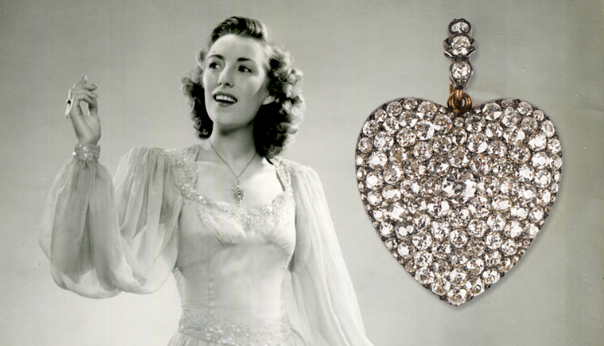
Dame Vera Lynn’s late Victorian diamond set heart shaped pendant locket

2022 saw some remarkable discoveries and sales at Toovey’s. It is always wonderful when remarkable and beautiful pieces are sold to the benefit of Sussex charities.

In The Sound of Music I love it when Julie Andrews sings “…These are a few of my favourite things.”

With many to choose from two of my favourite things from the 2022 auction season were the remarkable heart shaped diamond brooch sold for the Dame Vera Lynn Charitable Trust and the Duncan Grant Still Life in aid of The Sussex Heritage Trust.

During the Second World War Dame Vera Lynn was known as the Forces Sweetheart, a singer of undoubtable talent she became an icon of hope in the face of the sometimes seemingly insurmountable challenges of the Second World War.

The heart remains one of the definitive symbols of love and Dame Vera’s large, late Victorian diamond set heart shaped pendant locket, pavé set with old cut diamonds was a fine example. The smaller diamonds accentuated the principle stone at its centre within a shimmering field. The back was glazed and hinged with a locket compartment. This beautiful jewel with it’s exceptional provenance realised £26,000 for her charitable trust.

Later in the year a still life by the famous Charleston and Bloomsbury artist Duncan Grant was sold at Toovey’s in aid of the Sussex Heritage Trust.

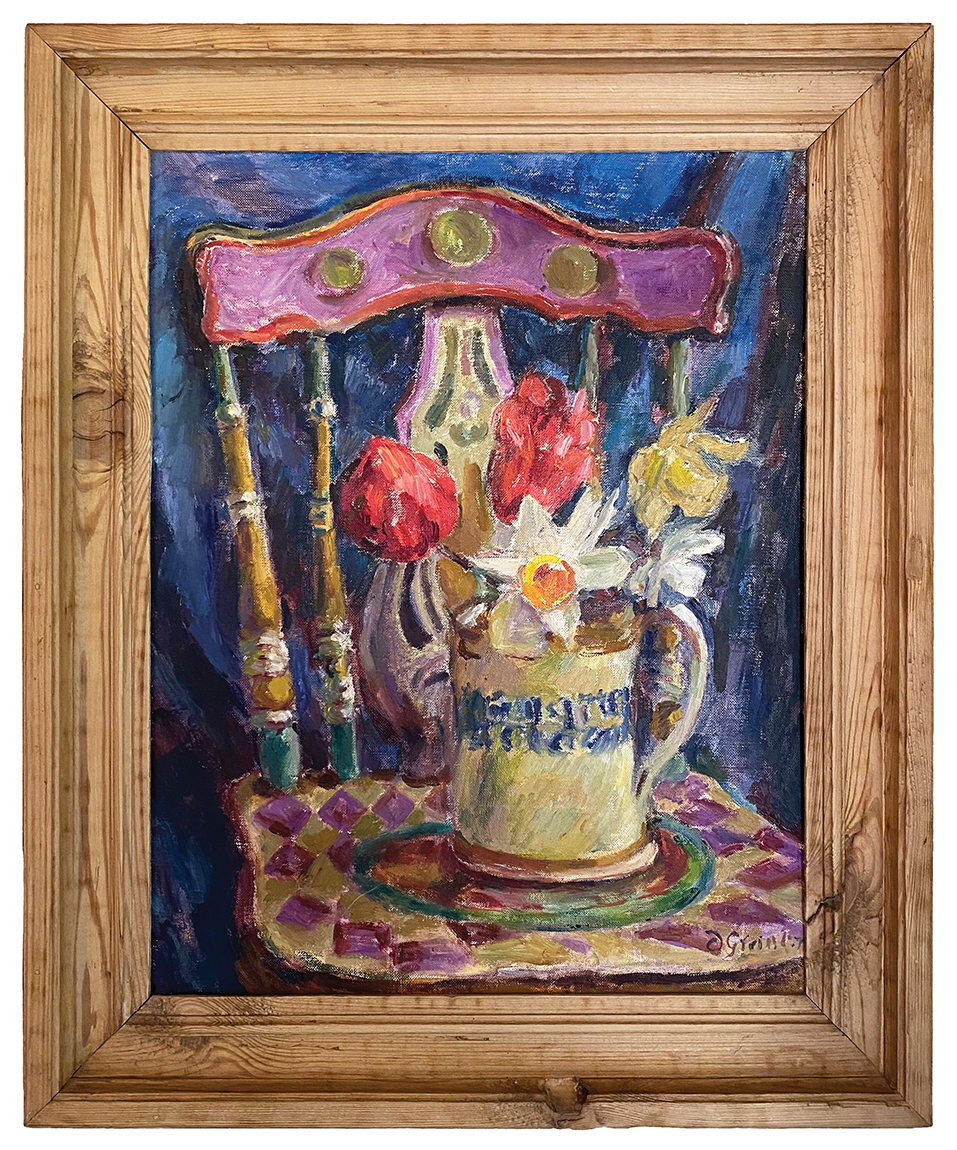
Duncan Grant (1885-1978), Chair with Flowers. Still Life, oil on canvas

The picture was donated to the Trust by Peter Carreras, a distinguished Sussex artist and printmaker, and his wife, Greta.

Duncan Grant’s painting provides a very British voice to the influences of Post-Impressionism. It depicts a handmade jug, of the type made by both Duncan Grant and Vanessa Bell, filled with flowers upon a painted Bloomsbury chair. His handling of the paint and the joyous palette reflects the art he and Vanessa Bell produced here in Sussex at Charleston. Although a later work the painting made £14,000 for the Sussex Heritage Trust.

When I founded Toovey’s some 28 years ago with my Dad, Alan, we wanted to model a different way of being business where people, our clients and team, were front and centre. And where the business was at the heart of the community supporting what is good in our county. It has been great fun and these values remain central to Toovey’s. Working alongside and in support of our county’s fantastic charities, museums, galleries and communities is, as it has always been, a great privilege.

Duncan Grant Painting to be Sold in Aid of Sussex Heritage Trust

Charleston House, Sussex

A still life oil painting by the famous Charleston and Bloomsbury artist Duncan Grant is to be sold at Toovey’s in aid of the Sussex Heritage Trust at 10am on Wednesday 30th November. It carries a pre-sale auction estimate of £6000-8000.

Through its work and awards the Sussex Heritage Trust promotes and encourages best practice in our county’s built environment and landscape.

The oil on canvas, titled Still Life with Bloomsbury Chair and Spring Flowers was donated to the Trust by Peter Carreras, a distinguished Sussex artist and printmaker, and his wife, Greta. It is believed that they purchased the painting in 1972 at The Ringmer Festival organised by the philanthropist Ian Askew.

Duncan Grant’s painting provides a very British voice to the influences of Post-Impressionism. It depicts a handmade jug, of the type made by both Duncan Grant and Vanessa Bell, filled with flowers upon a painted Bloomsbury chair. His handling of the paint and the joyous palette is reminiscent of Bloomsbury and although a later work it is a fine example. A very similar chair can be seen in Duncan Grant’s studio at Charleston House in Sussex and is thought to have been painted by Richard Shone in 1970.

Duncan Grant (1885-1978), Chair with Flowers. Still Life, oil on canvas

It was Vanessa Bell’s love for Duncan Grant and her sister Virginia Woolf which brought her to Sussex during the First World War. Vanessa was living with the artist Duncan Grant, and his lover David Garnett, at Wissett Lodge in Suffolk when her sister, the author, Virginia Woolf, wrote to her in the May of 1916. She extolled the virtues and potential of Charleston house near Firle in East Sussex. Virginia explained that not only did Charleston house need a tenant but that the neighbouring farmer was short of ‘hands’ to work on the land. Duncan Grant and David Garnett needed to be essentially employed on the land to avoid being called up to fight in the Great War or the prospect of gaol as conscientious objectors.

They covered the walls and furniture at Charleston with painted decoration. Duncan and Vanessa painted those who visited, the countryside around them and scenes from their home as can be seen in this still life.

The Sussex Heritage Trust’s work is important in promoting best practice in our county’s built environment and landscape whilst encouraging and supporting talented young people into careers in conservation, building and horticulture. I feel sure that the sale of this beautiful Duncan Grant Still Life will bless the Trust and its work.